

Member Spotlight:
Interview with HRTS Associates LA Co-President Cliff Decatrel
Head of Development & Producer, Associated Press Productions Transcript
Amidst massive change in our industry, HRTS Associates LA Co-President Cliff Decatrel, Head of Development & Producer, Associated Press Productions, redefined his career by forging a role that previously didn’t exist. Since he landed that job, he’s reached new heights, this year becoming a 2024 Academy and Peabody Award winner and Daytime Emmy nominee.
As he prepared to conclude his term as HRTS Associates LA Co-President, Cliff spoke with Melissa Grego, CEO, HRTS & Chair, HRTS Foundation, about how important learning to tell – and sell – a story, and his experience with HRTS, have been to his career.
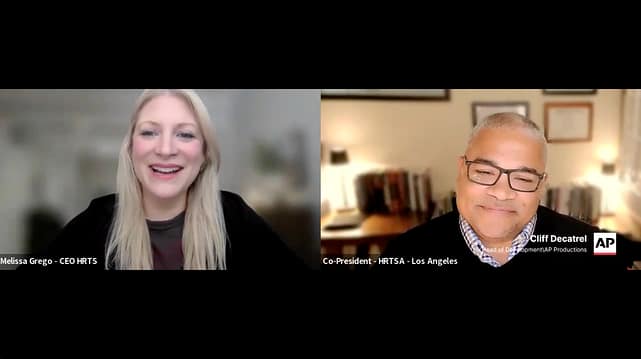
Click the image to view the 15-minute cut. Members may view the full 30-minute interview on the HRTS Channel.
Melissa Grego:
Hi. My name is Melissa Grego. I am the CEO of HRTS and chair of the HRTS Foundation.
I’m delighted to spend a few minutes with a member whose experience is a reminder of what is possible in entertainment even in the midst of massive change and upheaval in every nook and cranny of our industry.
This guest can speak to the power of partnership, creativity, consistency, continual learning, and, of course, relationships.
He has redefined his career in recent years and even reached new heights becoming an Academy and Peabody Award winner and Daytime Emmy nominee just in the past few months. So a big congrats and welcome to Cliff Decatrel, the co-president of HRTS Associates LA and head of development and producer at the Associated Press Productions.
Thanks for joining me today, Cliff.
Cliff Decatrel:
Thank you, Melissa, and thanks for having me.
Melissa Grego:
Absolutely. So I’d like to dive in by asking you to tell us about AP Productions and your role there. It’s a fairly new organization. Correct?
Cliff Decatrel:
Yeah. So, well, first of all, I’m really pleased to be here and a part of the organization. And, so AP Productions, obviously, it’s the Associated Press. We’ve been around for about six years.
And the first couple of years is really just sort of introducing this idea of AP producing, original programming, because for the last hundred years, we’ve always been supporting the industry with clips and information and images that the industry’s used in countless documentary series and other productions.
So now that we have started producing our own original programming, which is fairly recent. The company has really, I think, done something very unique, that most other companies that are in this space are are are doing as well, but we’re doing it quite differently, I think.
Melissa Grego:
So what are you doing that is different? For the most part, you’re co-producing with your partners who you’ve been serving with information and images and video. Correct?
Cliff Decatrel:
Right. So I think that, you know, our programming has been about fact-based, news-based, development.
And we’ve partnered with some of the best in the business, folks like Frontline, PBS, and ABC News.
And I think we’ve taken those partnerships to the next level. And we’ve always served the community of media news organizations, but I think now we’ve developed the kinds of relationships where we can take our stories, of which we produce, like, two thousand stories a day as a news organization and really curate those that are gonna be best suited for longer form storytelling.
Melissa Grego:
Now, let’s talk about your background leading up to this point and how that’s served you in this position. So in a lot of ways, you’re sort of matchmaking. Right? And sort of creatively plucking from these two thousand stories a day, you know, what might make a good match with a good network partner and studio partner for a larger story.
Cliff Decatrel:
Right. Exactly.
Yeah. I mean, I think the challenge is always curating when you have a large body of IP, but such as AP does, and finding those stories that really resonate with those producers and those networks and, series developers that are gonna take, make those the best for that particular organization. So it’s really understanding what their mandates are, having a sense for what their DNA is, and making sure that there’s a good match there. And like everyone else, you know, there’s true crime, and then there’s truthful storytelling around true crime, that is also based in AP standards, which is another critical aspect to this. So it can’t just be for us partners that, you know, wanna tell a really sizzling story. It has to be one that’s based in journalism, one that’s based in standards and practices that, you know, we try to uphold as a news organization as one that is journalistically sound.
Melissa Grego:
Tell us a little bit about your background, what you did before this, how long you’ve been with the AP, and, you know, how you find yourself in this position.
Cliff Decatrel:
Well, I think my history is long, but I will say that I’ve worked at a number of different cable and entertainment companies and news organizations. So for many years, I worked at Showtime Networks, worked at Sony Pictures Entertainment, and I’ve worked at some news organizations in New York, cable vision, News twelve. And what I learned in those positions is really how to sell a story and not just a story, but how to sell a concept.
And I think that was great background for me. I was in TV advertising.
We sold automotive advertising, real estate advertising to two of the toughest markets out there.
And if you know how to tell a story, I think you can get that through to people that are gonna green light and agree to move forward with, the possibility of building something together and making some important programming.
Melissa Grego:
Now you mentioned you worked in New York. You’re also from New York. Correct?
Cliff Decatrel:
Yes.
Melissa Grego:
Not that long ago, you moved west, correct, to really do this job. So, you know, there are so many people right now thinking about what direction can they go in literally and figuratively. So you went west, and it sounds like you also went north to your North Star, really, with this position. Right?
Sort of put it all together?
Cliff Decatrel:
Yeah. Sure.
You know, I was at AP for about a year and a half, and an opportunity, to move out west came along. My wife’s originally from Los Angeles, and I had always said if there was an opportunity, I would look into it.
And the opportunity was to license AP content, AP news content to the entertainment space.
And once I got out here, I recognized that there was a huge opportunity for us to continue to do the work – the good work – that we do to serve the organizations in news and entertainment, but perhaps there was also an opportunity to take it to another level. And I heard there was an organization that just started at AP called AP Productions, that I felt I would like to be a part of, and I brought an opportunity with a major studio to that organization. And from there, it was sort of like, well, gee, you know, you seem to like this a lot. Maybe this is something you should be doing for the organization.
And I think, you know, one of the things I’ve learned from that is that it doesn’t always work that way. I mean, but I do believe that sometimes if an opportunity doesn’t exist in your organization, you have to forge one. And, in this case, that was sort of what happened. And as a result of that, I’ve been part of that group for about five years.
And since that time, we’ve been very fortunate. We’ve had some great partnerships. We’ve had a lot of luck. You know?
And, also, I think we’ve had some stories that matter to people and that they really wanted to see more of. You know?
Melissa Grego:
Congrats.
And that’s so, I think, inspiring and something that, a lot of people in our community, it’s important to hear, you know, that, you don’t give up. You keep your eyes open. You apply that creativity and instinct, and then your ability to tell and sell a story can pull from anything you’ve done in your career at any time.
When we talk with our fellows who are, you know, really getting on their path, and might have a job where they’re not doing the thing that they’re dreaming of at the moment, it’s always helpful to remind them, like, hey. Every experience is worth something. You know?
I’m sure you weren’t planning while you were selling automotive advertising to television that, you know, specifically what you’re doing now is what you would be doing years later.
Cliff Decatrel:
Right.
Melissa Grego:
But really taking and learning all you can along the way is, I think really exemplary and helpful.
Cliff Decatrel:
I think that being in the TV business, there’s a lot of sort of osmosis learning that happens.
Right? So just being around production.
And, I was doing storytelling in a different way. It was commercial storytelling and building a TV campaign and building relationships and developing a really good pitch and developing, you know, the kind of relationships across a variety of roles within the organization and learning how to pitch up to management and all of those things, learning legalese.
Those things serve you when you have an opportunity. So it’s sort of like that luck is sort of preparation meeting, you know, opportunity. Right? So when when the opportunity came, I think I was able to seize on it.
But I do think that sometimes you do have to forge your own opportunities if you don’t see that before you. And and part of that is just sort of deciding that this is something you’re really passionate about. I mean, I, obviously, studied film and television, you know, early in my life in college, etcetera, and it’s always been something that’s been part of my DNA. But, you know, the opportunity to do it came even before I came to the Associated Press in developing some television programming for interactive TV channels.
So I think I sort of got my first taste of production probably fifteen years ago, and then just sort of was hoping to see that happen later on in my career, which I’m fortunate that it did.
Melissa Grego:
Awesome.
Finally, how and why did you get involved in HRTS and leadership within the organization?
Cliff Decatrel:
I get to work with people like you. That’s why.
You know, I’ve been a part of a lot of nonprofits and organizations in the DEI space and other spaces related to our industry, and I’ve always valued the relationships I’ve built, with those organizations. But I think there’s something incredibly unique about the folks at HRTS, and the organization that I lead with my partner, Cherish McDowell, is one where people are incredibly passionate about the industry.
They’re passionate about helping other people within the industry and lifting people up.
We talk about this all the time. You know? Like, mentoring is critical for us. Like, everybody on our board, you know, is probably involved in some aspect of the mentoring program. If not mentors themselves, then they’re helping to, find mentors for other people.
You know, the fellowship program, the philanthropy that we do, it is not just feel good. It feels right. And I think that is, you know, for those of us that like to give, back to the organization or the industry that really has allowed them to have a living and a life.
For me, it just it’s just a wonderful organization. The relationships I’ve built there, the friendships I’ve made, the access that I’ve gained, through those relationships, I don’t know another organization that I can think of that has done that as well.
Melissa Grego:
It’s really good to hear. I personally appreciate hearing that, and your involvement.
Any tips as far as what you could suggest others can do to tap into the organization, you know, who look at what you’ve done and what you are doing? And, you know, how can they be like Cliff?
How can they, you know, you know, tap into the organization to further their own career?
Cliff Decatrel:
Well, first and foremost, if you’re not already a member, become a member. Okay? And this isn’t a recruitment – Just really believe firmly.
You know? And people say, how do you do this? I go, come to an event. Come to a panel.
Come to a workshop.
Become a mentor.
Find a mentor. You know what I mean? That is really the answer to those questions, and every single one of those things matter. You know? We have events where we get to, you know one event that we did, earlier this year where we got to make, packages for, folks that are unhoused.
You know? And that was just an amazing event because you were networking, you were meeting people, you were hopefully doing something of tremendous value to the organization.
And, you know, it just feels really good to do that. So I wholly support that. The other thing I think that we’ve done well, certainly in the last couple of years, is partner with other organizations. And I think that brings in new ideas, new members, and new access.
And people talk about the industry and, well, you know, there aren’t a lot of jobs or they, you know, they and I say, you know, that’s true. It’s been challenging the last couple of years, but I think only through conversation and networking and developing relationships are you gonna find those opportunities that are harder to find than they were before. You know?
You know, the days of just sort of, sending out a resume or a reel are really kinda over. I’m sorry to break the news to people, but you really have to be out there meeting people and shaking hands. And your relationship, your reputation matters, but building the relationships matters even more, I think.
Melissa Grego:
Yeah.
Thank you so much for sharing all of this. It’s always really great to talk to you. So I will see you soon.
Cliff Decatrel:
Thank you. And thanks for all you do for the organization.
We couldn’t do half the things without you. So thank you.
Melissa Grego:
I appreciate you. Alright. Thanks. We’ll see you soon.